Off the Beaten Path
Off the Beaten Path
August 3, 2025
Belfast, Northern Ireland
Last night, I picked out my outfit for today: black pants, my pretty bright orange shirt, and white sneakers. We had a full day of walking ahead, and I wanted to be ready for it. But this morning, a text came in from Isabele: “Precautions to take when traveling into East Belfast.” At the top of the list: “No orange.” Then: “No green.” Orange for the Protestants. Green for the Catholics. Clothing here, like many communities at home, shows allegiance.
I stood over my suitcase for a long moment. A grown woman, staring at shirts. I reached for the white one. Neutral, I told myself.
We left the hotel after breakfast, again walking not driving. We had already covered a fair distance when an older man approached us near a small memorial garden where we had stopped to take pictures. “You better not go any further,” he said. “I’d turn around and go back.”
Lachlan didn’t hesitate. “Come on. You heard the man. Let’s head back.” But Isabele and I looked at each other. We were here to explore and try to understand what these communities were going through. We had walked West Belfast—the Catholic side. How could we not continue our walk east and visit the Protestant side of the city?
“I’m not going back,” Isabele said. “Neither am I,” I added. Lachlan exhaled, already frustrated. “This is a mistake.” But a soldier and protector through and through, he joined us.
The deeper we walked, the quieter it became. And then we heard it.
Thump. Thump. Thump.
The sound was dull, steady, and for us, deeply unsettling. It echoed through the stillness in a way that made everything feel staged, like an episode from my brother George’s favorite show growing up, The Twilight Zone.
Lachlan was now ahead of us, almost like he was on a reconnaissance mission. Isabele said to me in a whisper, “I feel like we’re in a horror movie.” We kept walking.
Thump. Thump. Thump.
What was this sound? Our minds filled in the blanks—none of them good. Someone beating something. Or someone.
We turned the corner.
A small boy stood alone on the sidewalk in front of his house. No more than five or six years old. In front of him sat an old bass drum. And he pounded it with mallets—one side, then the other.
Thump. Thump. Thump. Over and over again.
And then, above us, something broke through the rhythm. A mechanical voice singing, no chanting:
“Happy birthday to you . . . "
We looked up. Mounted high above the street, above the walls and the barbed wire, was a speaker. The song played on a loop. Tinny. Eerie.
The boy didn’t stop. The music didn’t stop. There was no one else around. My stomach twisted. It was the combination of it all—the drum, the looping birthday song, the emptiness of the street—that made it feel unreal. What I know now is that it was very real: It was the reality of a community living in fear and isolation.
The three of us took photos, hoping not to be seen. We took photos of the little boy, the row houses, the massive graffiti-filled cement “peace wall” topped with rusted barbed wire, and the loudspeaker blaring “Happy Birthday.”
Suddenly, rightfully so in retrospect, we became self-conscious. We felt like the intruders that we were, and we were acutely aware of not only how visible we were, but how we were probably being watched. The Peace Walls had cameras.
And then Lachlan said, “Let’s go!”
We retraced our path, the drum fading behind us, the music still looping somewhere above the walls.
“Happy birthday to you . . . “
Back in the city center, everything shifted—there were people moving about, cars whizzing by, and laughter from the pubs spilling out onto the cobblestone streets. But I couldn’t stop thinking about the boy—about how alone he seemed, and what it means to grow up in a place where colors and walls draw lines you didn’t choose, where your neighborhood defines you before you have the chance to define yourself. And I thought about what Pat, my driver, had said when I first arrived: “We’re all friends now.” Today, I understand the irony in his voice and the weight of that statement.
Bank Holiday
August 4, 2025
Dublin, Ireland
There’s supposed to be something special about threes: The third time’s the charm, and good things come in threes. Three is my favorite number, and John’s too. I always thought Lachlan, Isabele, and I would have that same kind of magic. But after today, I’m not so sure.
Another set of three: three stops. Two offices in Northern Ireland, then on to Dublin for a late-afternoon delivery.
We started strong, delivering packets to the Education Authority and the Catholic education office. But this was a very different experience from the world journey. There were no hugs like in Samoa, and no meeting with the head of education like in Tonga. Instead, there were very polite handoffs and something new: as we headed down the highway, I received an email confirming receipt of the packet for the chief executive of the Education Authority, Richard Pengelly. Isabele pulled off the road as we crossed the border into Ireland, and we celebrated the news with pastries and coffee at a farmers’ market that was surprisingly busy for a Monday.
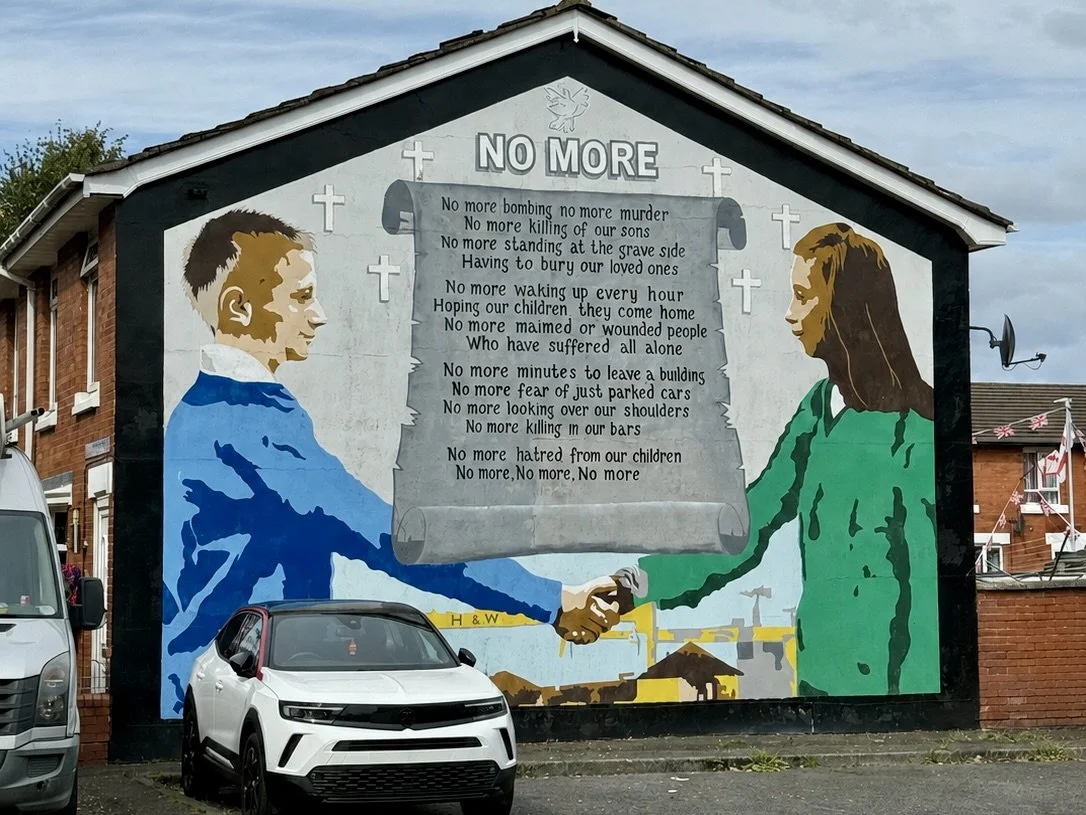
Sitting alone in the backseat, I entertained myself by looking through the photos I’d taken yesterday in East Belfast. I stopped on one that I snapped quickly but didn’t fully understand at the time. It was a peace mural with the words NO MORE at the top and a boy in blue and a girl in green shaking hands. Behind the children were these words written on a scroll:
No more bombing no more murder
No more killing of our sons
No more standing at the graveside
Having to bury our loved ones
No more waiting up every hour
Hoping our children, they come home
No more maimed or wounded people
Who have suffered all alone
No more minutes to leave a building
No more fear of just parked cars
No more looking over our shoulders
No more killing in our bars
No more hatred from our children
No more, no more, no more
Seeing children from rival communities making peace made me think about a classroom I had visited years ago at Markham Middle School in Watts.
I sat with a group of students during an Overcoming Obstacles team-building activity. Their task was to create a flag that united them. These children came from different backgrounds, many with ties to rival gangs. But as I watched them work together, I saw something powerful take shape. Their flag wasn’t defined by what separated them—no blue for Crips, no red for Bloods. Instead, they drew games: football, soccer, baseball, basketball. It became their version of a peace flag. Sports united them. I wondered: Why can’t adults do the same?
The children in Watts were real. At this point, the children in Belfast working together was just art on a building. I was eager to get to Dublin for another packet delivery. Something about getting information into the hands of educators and education leaders calms my mind.
But as we approached Dublin, our day began to unravel. Lachlan and Isabele were raising their voices. I couldn’t tell what the issue was. But I remembered that when John and I fought—which was rare—it was during car trips. Even when I had control of the wheel, he wanted to drive.
It was Isabele who was behind the wheel, but Lachlan wanted control. To make matters worse, I had changed Lachlan’s detailed CONOPS plan for the trip down from Belfast. We were originally set to leave tomorrow, Tuesday, but I felt like our work was done in Northern Ireland and we should head south after the successful delivery of our two packets. Lachlan—trained military, highly skilled in logistics and strategy—was thrown off by my insistence on a change on the fly. It disrupted everything, including our relationship.
We took the off-ramp the navigation app suggested and made our way to the address we had for the Department of Education. Lachlan wanted to find a place for Isabele to park and then we would walk from there. It was raining. I thought: Let’s just pull up. We’ll go in, and if Isabele needs to move the car, she will—we’ll call her. Lachlan said, “No.” I told him how Jane and I rolled on the Queen Anne: We’d get eyes on the building first, get out, and keep the car nearby in case we had the wrong address. Again, I heard “no.”
Control is a strange thing.
I couldn’t help but think: Strike one.
We parked far away. Lachlan and I walked in the rain. And when we arrived at the building, no people, no life at all. Still, we kept going. We circled the building again and again. Nothing. No one.
Lachlan didn’t want to give up. I had had it at that point. Wet, tired, and frustrated. We’re not in the army, I thought. We could try again tomorrow. My dad would say, “Nothing ventured, nothing gained.” We tried. Now, abort mission—at least until tomorrow. I told Lachlan we needed to go back to the car. As we reached the street, we saw a young woman walking by. Lachlan asked, “Is this the correct address for the Department of Education?” The young woman said, “This is the building, but it’s closed. Bank holiday.”
“A bank holiday?” I asked. “What is that?”
Lachlan said, “It’s a public holiday.” He read aloud from his phone: “There are ten official public holidays, or bank holidays, in the Republic of Ireland, as established by the Organization of Working Time Act 1997. These include fixed dates like St. Brigid’s Day in February, St. Patrick’s Day in March, Christmas in December, and several ‘first Monday’ holidays, including in May, June . . . “
He paused, then added, “August.”
I felt deflated, then anxious. Lachlan? He was clearly angry with himself and with me. Had we stayed with his original plan, we would have arrived in Dublin on a Tuesday, and the education offices would have been open. Instead, we were cold, wet, and frustrated.
We walked back to the car in silence. As we made our way to the hotel, no one spoke. I couldn’t help but wonder: If something this small could unravel us, what would the weeks ahead bring?
When we checked into the hotel—one of the nicest we’ll stay in this summer—I saw it for the first time: how the Murrays travel. They’ve been backpacking across the globe for years, and they’ve learned to carry their world with them wherever they go. Each of them carried all their clothes, toiletries, and personal belongings in enormous backpacks strapped to their bodies. Isabele had a bedroll fastened beneath hers. Lachlan had the one suit he travels with hanging from the front of his body on a hanger somehow hooked to the backpack’s chest strap. Sneakers dangled from the back of his pack. I’d never seen anything quite like it. And the sight of these two incredibly fit, attractive people—with the broadest smiles I’d ever seen—carrying everything they owned into a swanky hotel? If I’d hoped we might travel subtly and stay under the radar, that fantasy was officially over.
So, thinking everything through about the Murrays and me, these things I know are true: Lachlan, Isabele, and I care deeply about this mission. We all want to see life skills education brought to the communities of Ireland and the UK. I never would have made this trip without them. They conceived the idea and planned every step of the way. We must figure out a way to work together. I just can’t take more days filled with anger and fighting. If the children of Markham Middle School can create peace, we should be able to as well.
But another famous three comes to mind as I close my journal for the night: three strikes and you’re out. I hope no one is keeping count of ours.